
[October 2026]
The Increasing Threats to Our Society and Way of Life
For a 30-year-old making financial plans for their career and retirement over the next fifty years, seeing through even the next decade requires real optimism.
The nature of work is changing rapidly. In March this year, Goldman Sachs estimated that over 300 million jobs globally will be affected by AI. Climate change is already affecting society in profound ways, with the United Nations flagging that over 250 million people have been displaced due to extreme weather over the last decade, a figure likely to rise. And a growing concern for many in Western Europe is that the threat of large-scale war to our homelands and way of life is greater than at any point in recent decades. A recent Atlantic Council survey found that 40% of strategists and forecasters believe ‘a multifront conflict among great powers’ will occur by 2035.
Conversely, there are real opportunities: AI is producing millions of new jobs. Green energy and carbon capture technology is improving. Defence spending is increasing.
Societies have a fundamental role to play in driving those more positive outcomes. To shape the results we seek – ones which represent cohesive and collaborative societal values, and which ensure the prioritisation and sustainability of national and international security – requires a proactive and collective approach both nationally and in partnership with allies.
This starts with building a shared understanding across society of the scale and nature of the threats faced. Communicating that understanding needs to become a much higher national priority. Government, academia, the media, businesses, security agencies and others all have a role to play in raising awareness of what these threats mean, how they could affect our nations, and what it means to prepare for them effectively.
Preparation is therefore a key component of readiness and resilience, but one which hitherto has been largely absent from discussions on the whole-of-society approach to defence in the UK.
Increasing Whole-of-Society Engagement
Concerns over that uncertain future and the threat of major interstate conflict are high amongst defence and security specialists. Politicians too are becoming increasingly vocal. Australian defence minister Richard Marles speaks of the country living in ‘the most dangerous times’ it has faced since the end of World War II. Former UK prime minister Sir Keir Starmer noted “it is our intelligence assessment and the assessment of other countries in NATO that there could be an attack by Russia on NATO as soon as 2030.” US Defense Secretary Pete Hegseth, speaking at the Shangri-La Dialogue last year, said “there’s no reason to sugarcoat it. The threat China poses is real, and it could be imminent.”
A YouGov poll in 2025 showed that roughly half the population of France, Spain, Italy, Britain, the US and Germany think that another world war is fairly to very likely, with a 2022 US poll showing a similar percentage. The willingness to do something about this, however, appears to vary dramatically with age and geography. The same poll showed 76% of Britons over 65 were prepared to spend more on defence, dropping to 31% for 18–25-year-olds. A Riga Stradiņš University and Center for Geopolitical Studies survey of NATO members, published in 2026, showed that the willingness to fight for one’s country varied from 25% in Italy to 88% for Turkey.
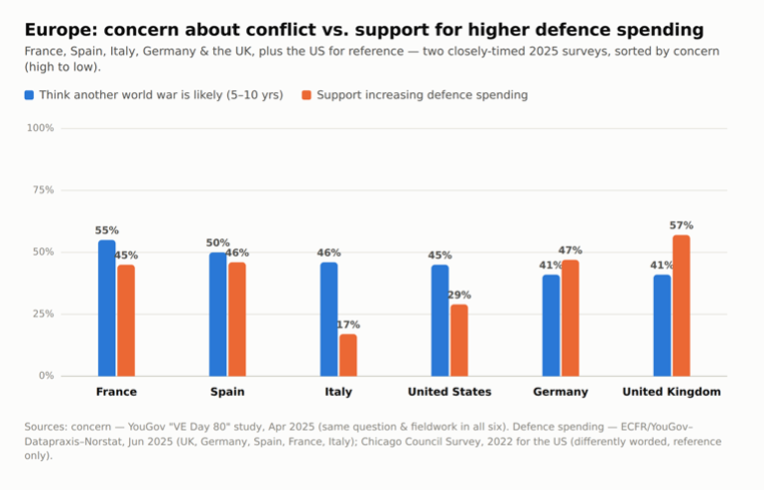
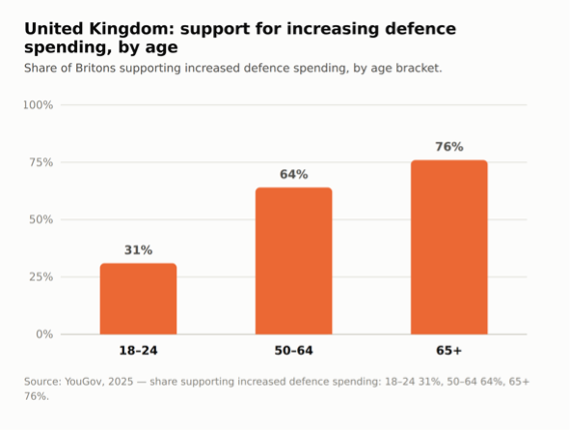
While research shows there are multiple factors which impact the public perception of threat and willingness to invest in countering it, a British Journal of Political Science study showed that the way in which we communicate and engage with society dramatically changes this perception. Framing the potential personal impact of conflict more vividly had a significant effect. Meanwhile, amid talk of ‘building resilience’ and ‘nurturing innovation’ in speeches, the UK Strategic Defence Review, and elsewhere, what it means to ‘bring people on the journey’ as we face ‘an increasingly uncertain future’ remains somewhat unclear for wider society. Where opportunities to facilitate a productive society-wide conversation on defence have presented themselves, such as in UK proposals to re-introduce national service, they have often been insufficiently capitalised on. For example, while opportunities for economic growth have been highlighted as key benefits to increased defence spending, there appears to be less awareness of this need for increased spending being borne out of the changing threat landscape the UK faces.
To bring about such a significant shift, more effective engagement is necessary: to help society understand that everyone can make a personal contribution to increased resilience. This means better explaining the threats we face, the potential consequences if these are not mitigated, the benefits of increased defence expenditure in preventing and, if necessary, preparing to face them, and the plethora of practical ways individuals can contribute. The latter may be as simple as stockpiling water and tins to increase resilience, to working in critical industries, to deciding to join either reserve or full-time military service. The UK Government’s Resilience Action Plan details the work and research being done to assess societal resilience and preparedness, while recognising that significant behavioural and cultural changes are needed to support resilience efforts. The Prepare Campaign provides accessible information about how households can be better equipped to manage during an emergency scenario for example, and it is important that the UK learns from others’ preparedness processes as well. For example, countries like Sweden and Finland offer valuable insights into how the UK might prepare more effectively, and in September 2026 the UK National Resilience Committee visited Finland to observe an emergency preparedness exercise. Being effective in preparedness terms requires a whole-of-society approach to security and resilience, and particularly the need to truly embrace and embed integration and inclusivity across the defence workforce.
Engaging the Whole of Society in Defence and Resilience
Deterrence requires a nation to show it is not only prepared for conflict; it must show it has the scale and resilience for a long war. In 2024, then-Chief of the General Staff, General Patrick Sanders, stated that, ‘Ukraine brutally illustrates that regular armies start wars; citizen armies win them.’ For nations with a professional military like the UK, it must be able to demonstrate that that it can provide security and support in a more versatile, agile manner that reflects and incorporates the capabilities of the population. Facilitating this in a way which engages today’s society will involve the fostering of a more flexible and inclusive military culture and defence workforce that draws on people’s skillsets strategically rather than trying to reshape them to fit a traditional military model.
To effectively engage with and integrate wider parts of society in protecting the nation means focusing the range of ways in which people can contribute to defence and national resilience. Recognising this, developing these abilities, and ensuring people entering the defence workforce are treated equitably and well-supported is both morally imperative and essential to developing a much more graduated way of scaling up the force as the threat level increases.
This does not mean that everyone is suddenly in uniform, but rather that there is a greater awareness of how different skills can contribute to more effective defence and security outcomes, drawing on a range of diverse talent from across the nation. We need to recognise that we all have a role to play, and these roles will take different forms as the nature of security and warfare evolve and change over time.
Demonstrating readiness requires the creation and implementation of a much more seamless recruitment process and flexible model of how people are involved in defence. For example, in the UK there are ongoing discussions about developing the use of reservists in defence and the protection of critical national infrastructure, and an ambition that the numbers of reservists will increase in the coming years. The Strategic Reserves, former Service personnel with varying degrees of recall and training liability, appear frequently in conversations on increased warfighting readiness. For example, should it pass into law, the Armed Forces Bill 2026 would increase recall liability to age 65 and enable the Secretary of State to implement such a recall order for ‘warlike operations’.
However, utilising Reservists – both volunteer and strategic – effectively requires greater engagement with them and their employers. This is extremely pertinent as 2027 will see the first major mobilisation of the UK Strategic Reserve in decades. For this to be a success, it must act as an opportunity to implement lessons learned from the years of insufficient engagement and lack of communication and use these lessons to build a stronger foundation of resilience and preparedness.
This need for engagement and collaboration extends to industry as well. A recent study found that 46% of UK respondents aged 13-27 years old had little or no openness to opportunities in the defence sector. In other analysis, Defence doesn’t feature in the list of the 10 fastest-growing industries for U.K. grads. There are various reasons why this might be the case, but fundamentally it comes down to a lack of clarity on what defence is, what it entails, and what it protects. This is a problem of ineffective communication and engagement with the next generation and requires a cross-generational, cross-society conversation to rectify.
There is also the need to embed more adaptive capacity measures into industries that have the potential to switch from being purely commercial to military and defence focused. This too requires a culture change and necessitates a whole-of-society reframing of how defence and security are conceptualised and how these concepts transcend the boundaries of different sectors. So, while the professional military has historically been the basis on which we scale up, there is a more holistic, comprehensive option available.
In a relatively short period of time, we will have to move to a position where UK society feels that security is not only something that affects them, but that they can influence. This sits alongside the need to embrace technology but equally to be critical of it, ensuring that human input drives innovation.
Conclusion: We All Have a Role to Play
Restoring both the reality and optimism of our young people about the future requires leadership, nationally and internationally, to:
- More vividly communicate both the likelihood of conflict and its impact on individuals’ lives and families.
- Support more integrative, innovative workforce cultures.
- Strengthen focus on mobilising, integrating, scaling, and reconstituting in wartime.
- Foster a cross-sector, cross-society approach that offers practical ways for people to engage with and in defence.
- Centre the human element in defence by prioritising employee wellbeing, incentivisation, and professional development.
If leadership can change the conversation, and our societies can embrace the resulting opportunities, we can create far greater societal involvement and the agency and understanding that is essential to steering our way through the challenging decades ahead.
This essay is from the Security & Defence PLuS Emerging Voices Series, which highlights the next generation of scholars and practitioners shaping thinking on strategy, security, and defence. The series brings together perspectives from PhD candidates and early career researchers, grounded in the complex geopolitical realities of the 21st century.
The second event in the Emerging Voices series was held at King’s College London on 18 June 2026, a previous event took place at ASU and another will follow at UNSW. Watch the event recording: The Emerging Voices Series: Strategy, Security & Defence at King’s College London.
Disclaimer: The views and opinions expressed in this essay are those of the author and do not necessarily reflect the views of Security & Defence PLuS or its partner institutions.