
[August 2026]
Power Maximisation in the Indo-Pacific: China’s Maritime Assertiveness in the South China Sea
The recent incursion of a Chinese Coast Guard (‘CCG’) vessel into Indonesia’s exclusive economic zone (‘EEZ’) is a stark reminder of China’s sustained campaign to assert itself in the South China Sea under the guise of defending the so-called Nine-Dash Line (‘9DL’) – a claim dismissed a decade ago in the Permanent Court of Arbitration. Incursions like these are frequently employed by China and represent just one of many greyzone tactics designed to threaten the territorial integrity of neighbouring states. This encroachment, which also includes the resumption of its island-building campaign in the Paracel Islands, forms part of China’s intimidatory behaviour and resembles power maximisation in the Indo-Pacific.
Herein lies the central strategic challenge facing states in the Indo-Pacific, for if China continues with its assertive maritime posture, there is a risk that one state could control seaborne trade, while exploiting others’ marine and offshore natural resources. Such a scenario would ultimately disrupt the rules-based maritime order in that region, and considering a third of the world’s seaborne trade passes through the South China Sea, the economic impact would be felt globally. What would transpire is a situation not too dissimilar to the Strait of Hormuz currently, but how can we know if China, as a regional hegemon and now peer-competitor to the US, would not go further with its expansionist ambitions? So far we see these ambitions promoted by the CCG, which boasts the world’s largest surface fleet and most-armed, as well as an expansive fishing militia. These forms of seapower assert China’s authority in a low-intensity way, without provoking a conventional military response from others.
At the heart of this strategic expansionism is the 9DL – a claim which encompasses approximately 80 percent of the South China Sea, including the Paracel and Spratly Islands, Scarborough Shoal, and the Macclesfield Bank. The U-shaped line first appeared in a 1936 map produced by the nationalist Chinese geographer, Bai Meichu, yet most of the islands and features were subject to contestation even before this, especially from Vietnam and the Philippines.
Despite Chinese scholars regularly arguing over time that the 9DL acts as China’s maritime boundary, ambiguity arises due to the fact that many versions of Chinese cartography feature a different number of dashes. For example, a 1948 map by the Republic of China featured 11 dashes but was later amended to nine in 1953. Contemporary maps have 10 dashes to incorporate the waters east of Taiwan to appeal to a nationalistic audience. The dashes themselves have never been attributed specific geographical coordinates, nor are they uniformly distributed. Some are separated from one another by between 106 and 274 nautical miles, with some placed closer to the mainland coasts and coastal islands of neighbouring states than the actual islands China claims.
Along with these cartographic inconsistencies, parts of the line overlap with the EEZs of neighbouring states like Vietnam, Brunei, Malaysia, Indonesia, and the Philippines. Under the United Nations Convention on the Law of the Sea (‘UNCLOS’), of which China is a signatory yet seldom observes, a state’s territorial sea extends only 12 nautical miles from its recognised baseline, while its EEZ may extend to 200 nautical miles. The EEZ provides ‘sovereign rights for the purpose of exploring and exploiting, conserving and managing the natural resources’.
Considering how resource-rich the South China Sea is, freely exercising these legal rights is critical to the economic development and, in turn, national security, of many southeast Asian states. Though for China, which is the world’s largest oil importer and second-largest consumer of oil, the South China Sea offers an opportunity to bolster energy independence through offshore and deep-water oil and gas discoveries. The US Geological Survey, considered one of the most authoritative in the world, reported in 2023 that undiscovered resources in the 13 basins collectively contain anywhere between 2.4 and 9.2 billion barrels of oil, and between 62 and 216 trillion cubic feet of gas. The underexploration of these waters, and abundance of offshore resources, helps explain why contestation of the South China Sea is about far more than defending sovereignty claims under the 9DL, and is part of a broader strategic contest over influence and access.
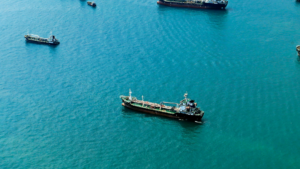
So, what tools of seapower are employed to assist in achieving such strategic objectives? As previously mentioned, a large part involves greyzone tactics like deploying hundreds of fishing vessels, which essentially forms a paramilitary maritime militia. There are cases where over 1,000 vessels are deployed. These fleets have increased significantly under President Xi as the selection of subsidies to provincial and local governments, whose jurisdictions include offshore and inshore fishing, have expanded dramatically. Beyond fuel subsidies, so vessels can travel further, there are subsidies for the installation of communication, navigation, and safety equipment.
These policies correspond with what Xi himself said on a visit to the fishing village of Tanmen in 2013, where he urged fishermen to ‘build bigger ships and venture even further into the oceans to catch bigger fish’. And since local governments compete for funding, they are more than likely to encourage and advance Beijing’s policy ambitions. Moreover, these fishing vessels are often escorted by CCG vessels, forming a flotilla which is difficult to manage for neighbouring states that traditionally have an under-developed coast guard.
Further to this militarisation is the infamous industrial-scale, island-building campaign which includes the installment of civilian and military facilities. Mainly conducted on reefs, these islands can house regiments of fighters, and are capable of deploying air assets, surface-to-air and surface-to-ship cruise missiles. Although island-building was flagged in the 1990s to make it more convenient for the navy to resupply and undergo maintenance, it was not until 2013 that the policy was fully embraced. Xi accelerated the campaign after PLA analysts judged that the US was preoccupied with the Middle East and Russia, believing the time was ripe to expand China’s ‘security perimeter’. This logic aligns with China’s long-standing concern about wei qi – the prevention of strategic encirclement by any power. China’s land reclamation now totals more than 2,210 hectares and has been done without any real consequences.
This attempt to reshape the regional order and limit others’ freedom of navigation in the South China Sea is akin to power maximisation by a regional hegemon, especially one that is now a peer-competitor to the US. Indeed, years of mass military modernisation from China, funded by its rapid economic rise, has seen the People’s Liberation Army Navy become the largest in the world and showcase considerable hard power. This is sustained by a shipbuilding capacity that far outweighs the US. Meanwhile, the US’ naval fleet has halved since the end of the Cold War, and its shipbuilding capacity has been dogged by years of underinvestment and production shortfalls. This is a consequence of the US being over-stretched for two decades, thanks to its foray in democratic globalism, and now consumed in another Gulf war. All of this is ideal for the continuation of China’s naval buildup as it attempts to gain power in its own periphery.
Since there has been no meaningful progress in the finalisation of a code of conduct on the South China Sea between China and ASEAN, something which was first flagged in the 1990s and a process that has been consumed by disagreements over whether or not a code should be binding – China has been able to shift the balance of power towards to a more favourable position without suffering a considerable price. It is suggested that China only ever engaged with ASEAN to deliberately reduce the role of the US throughout the process. What has followed is disunity among ASEAN member states as some are disinterested in being part of strongly-worded communiques on behalf of claimant states. The ambivalence by some states is undoubtedly driven by their deep economic ties to China and much-needed foreign investment for urban projects via China’s key foreign policy vehicle – the Belt and Road Initiative. This illustrates the limitations of the region’s multilateral response, but also how China’s obfuscation of the process serves its strategic interest.
What is increasingly clear is that China’s assertive behaviour in the maritime domain has moved well beyond isolated territorial disputes, and become part of a deliberate strategy to influence and, ultimately, control its own periphery. The cumulative effect of greyzone tactics such as its island-building campaign, or employment of the CCG and maritime militia across the South China Sea, mixed with its naval buildup, points to a militarisation which threatens the wider regional order. Responding to this challenge requires more than diplomatic protest or an excruciatingly slow code of conduct process – it requires deeper security ties among like-minded partners within the region.
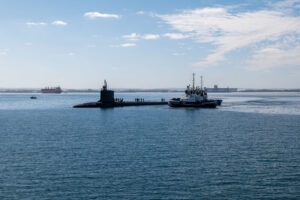
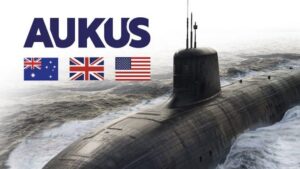
The trilateral AUKUS security pact is one such example of a collective approach to Indo-Pacific security, although it would be strengthened if industrial integration expanded to include Asian partners that have advanced shipbuilding capacity, like Japan and South Korea. Large-scale multinational military exercises like the annual Balikatan, which involved 17,000 personnel from the US, Philippines, Canada, France, Japan, Australia, and New Zealand, equally encourages broad cooperation and military interoperability. Japan’s full participation this year in Balikatan marked a strategic shift for the Indo-Pacific’s security environment.
In any collective security response, the guiding principles ought to be whether it can be delivered, sustained, and then ultimately demonstrated. For a deterrent ceases to be one if neither of these can be achieved. That is the challenge for Indo-Pacific states that share a common strategic interest in maintaining a balance of power, and protecting the rules-based maritime order from the frequent traditional and non-traditional security threats posed by China’s assertive behaviour – typical of a regional hegemon.
This essay is from the Security & Defence PLuS Emerging Voices Series, which highlights the next generation of scholars and practitioners shaping thinking on strategy, security, and defence. The series brings together perspectives from PhD candidates and early career researchers, grounded in the complex geopolitical realities of the 21st century.
The second event in the Emerging Voices series was held at King’s College London on 18 June 2026, a previous event took place at ASU and another will follow at UNSW. Watch the event recording: The Emerging Voices Series: Strategy, Security & Defence at King’s College London.
Disclaimer: The views and opinions expressed in this essay are those of the author and do not necessarily reflect the views of Security & Defence PLuS or its partner institutions.